Gelato vs Printify: Which POD Provider Fits You?
Gelato and Printify are both print-on-demand platforms, but the best choice depends on your orders—not a universal winner. Gelato is built around routing production through a global local-production network. Printify gives sellers a marketplace of print providers to compare by product, location, price, and performance.
The right decision comes from testing the exact product, destination, and sales channel you expect to use. Compare landed cost and delivery reliability, not the cheapest catalog price.
Gelato vs Printify at a Glance
| Criterion | Gelato | Printify | What to verify yourself |
|---|---|---|---|
| Network model | Distributed production network with local routing | Provider marketplace with seller-selected providers and routing options | Who produces your exact SKU in each destination |
| Best fit | Sellers prioritizing international reach and local production potential | Sellers prioritizing product and provider choice | Your top products and customer countries |
| Product selection | Strong in core apparel, wall art, stationery, drinkware, and more | Broad catalog across many independent providers | Exact sizes, colors, print areas, and availability |
| Pricing | Product, shipping, destination, and plan affect cost | Provider, product, shipping, destination, and plan affect cost | Landed cost for a real order |
| Quality consistency | Can vary by product and routed facility | Can vary by chosen provider and backup routing | Samples from likely facilities |
| Integrations | Direct integrations plus API and intermediary options | Direct channel integrations plus API options | Whether your channel and required actions are supported today |
Features and prices change. Use this table as a decision framework, then verify current product pages, integration docs, and a physical sample.
The Most Important Difference: How Production Is Chosen
Gelato emphasizes producing near the recipient when capacity and product availability allow. Its current network page says it has local production in 32 countries, while its help center warns that an order may still route elsewhere for stock, capacity, or logistical reasons. Read Gelato's explanation of where orders are produced.
Printify exposes individual print providers in its catalog, letting you select among available producers for a product. That can give you direct control over price, location, variants, and provider performance, but it also asks you to make and maintain that choice.
The practical distinction:
- Choose Gelato when broad geographic routing is central to the strategy.
- Choose Printify when selecting and comparing specific providers is central to the strategy.
Neither model guarantees that every order will be produced at the closest or preferred facility. Confirm availability and routing for the exact product.
Compare Landed Cost, Not Base Price
A POD catalog price is not your cost to serve the customer.
Use:
Product cost + print options + shipping + taxes/duties you absorb + platform fees + expected replacement cost = landed variable cost
Run the calculation for your five most likely combinations:
- Best-selling product to your main country
- Expensive size or variant to your main country
- Best-selling product to your second-largest market
- Remote destination
- One replacement order
Then compare contribution margin at the same retail price. A provider that is €1 cheaper on the blank can still be more expensive after shipping or a lower first-pass success rate.
Compare the Exact Product, Not the Catalog Count
A huge catalog has no value if it lacks the product you can sell repeatedly.
For each finalist, compare:
- Available sizes and colors
- Printable area and placement options
- Print method
- Garment or product brand
- Country-level availability
- Production estimate
- Shipping services and tracking
- Branding options
- Mockup quality
- Replacement and claim process
Create a pass/fail product brief before browsing providers. This prevents attractive but irrelevant options from steering the decision.
Test Quality With a Blind Sample Scorecard
Order the same design on the closest equivalent product from both platforms. If possible, send samples to the countries where most customers live.
Score each sample without looking at the provider name:
| Test | Weight | What to inspect |
|---|---|---|
| Print accuracy | 25% | Color, placement, sharpness, small text |
| Product quality | 20% | Fabric/paper/object construction and feel |
| Consistency | 20% | Difference between repeated orders |
| Delivery | 15% | Production time, tracking, transit, damage |
| Packaging | 10% | Protection, presentation, unwanted inserts |
| Support | 10% | Speed and quality of issue resolution |
One perfect sample is not proof of consistency. Reorder a winning SKU later and inspect whether the result repeats.
Compare Delivery Where Your Customers Actually Live
Do not use a global average for a local decision. Build a destination matrix:
| Product | Destination | Production estimate | Shipping estimate | Total landed cost | Tracking quality | Local production likely? |
|---|---|---|---|---|---|---|
| Your SKU 1 | Country A | |||||
| Your SKU 1 | Country B | |||||
| Your SKU 2 | Country A |
Gelato says its network can deliver to more than 200 countries, but it also states that not every product or format is produced in every country. Check the exact catalog location instead of turning “local production” into a blanket promise.
Compare Integrations by Workflow Depth
“Integrates with Shopify” is not enough. Ask what the integration can do:
- Publish new products
- Map existing products
- Sync variants and SKUs
- Import orders automatically
- Return tracking to the store
- Sync cancellations
- Handle personalized artwork
- Route orders from secondary marketplaces
- Expose status through an API
Gelato currently lists direct integrations with Shopify, Etsy, WooCommerce, Wix, Squarespace, and BigCommerce, with other paths through Order Desk, manual ordering, and its API. Its broader integrations page also describes additional channel support that can be region- or beta-limited. Verify the current Gelato integration list for your account and market.
For either platform, prove the workflow with a real test order. A logo on an integrations page does not prove that every field or exception syncs the way your store needs.
Compare Branding and Customer Experience
Your customer sees the product, package, tracking, and support outcome—not the provider dashboard.
Check:
- Whether branded labels or inserts exist for the product and destination
- Whether the parcel contains provider marketing
- What sender name appears on tracking or labels
- Whether multi-item orders split into separate shipments
- How the provider communicates delays
- Whether the return address fits your policy
If branded packaging matters, verify it on the exact SKU. Provider-level feature pages often describe options that are not universal across products and locations.
Compare Failure Handling Before Happy-Path Speed
The best provider is often the one that creates the least damage when something goes wrong.
Run these scenarios on paper:
- The selected color goes out of stock after an order.
- Tracking is created but never moves.
- The print is visibly misaligned.
- A customer enters an incomplete address.
- Two products in one order are made at different facilities.
- A marketplace requires a refund before the provider decides the claim.
Record who pays, who acts, the deadline, what evidence is required, and what the customer is told. This is more predictive than a small difference in catalog price.
When Gelato Is the Better Fit
Gelato is usually the stronger candidate when:
- Your customers are spread across several countries.
- Posters, wall art, stationery, or core apparel match its network well.
- Local-production potential is worth more than choosing a named provider.
- Your sales channel has a sufficiently deep direct integration.
- Your tests show better landed cost or delivery consistency in target regions.
When Printify Is the Better Fit
Printify is usually the stronger candidate when:
- You want to compare multiple providers for a specific product.
- Product breadth or a particular blank is decisive.
- You want more control over which provider fulfils a SKU.
- Your primary market is served strongly by a selected provider.
- Your tests show better margin, quality, or repeatability for the winning product.
For the practical upload workflow, read how to bulk upload to Printify.
When You Should Use Both
Using both can reduce supplier concentration, but only when the catalog remains controlled.
A clean dual-provider strategy:
- Assign one primary provider per SKU.
- Maintain one tested backup only for important products.
- Keep separate provider SKUs and mapping records.
- Do not auto-route to an untested substitute.
- Recalculate margin before switching.
- Confirm the replacement product matches the listing.
Two providers without a mapping system create more risk, not less.
A 60-Minute Decision Process
Minutes 0–15: Define the order profile
List your top three products, top three destinations, required sales channels, and minimum contribution margin.
Minutes 15–30: Eliminate non-matches
Remove any option that lacks a required product, variant, location, integration, or branding feature.
Minutes 30–45: Calculate scenarios
Compare landed cost for normal, expensive, international, and replacement orders.
Minutes 45–60: Order samples
Use the same artwork and closest product match. Do not choose the winner until the samples and tracking experience arrive.
Frequently Asked Questions
Is Gelato better than Printify?
Gelato is not universally better than Printify, or vice versa. Gelato's routing model can suit internationally distributed demand; Printify's provider marketplace can suit sellers who want product and provider choice. The winning option is the one that performs better for your exact SKU and destinations.
Is Gelato or Printify cheaper?
It depends on the product, provider or production location, destination, shipping method, subscription, and replacement rate. Compare total landed cost at the same retail price.
Can I use Gelato and Printify at the same time?
Yes, but assign each SKU a primary and tested backup route. Keep product mappings clear so the wrong blank, color, or print specification is never substituted automatically.
Does Gelato always print locally?
No. Gelato says local production depends on product availability, capacity, and logistics, and some orders may route internationally. Check the expected production locations for the exact product.
Bottom Line
Choose on evidence: exact product, exact destination, landed margin, sample quality, integration depth, and failure handling. Gelato's global routing and Printify's provider choice are meaningful differences, but neither replaces a real order test.
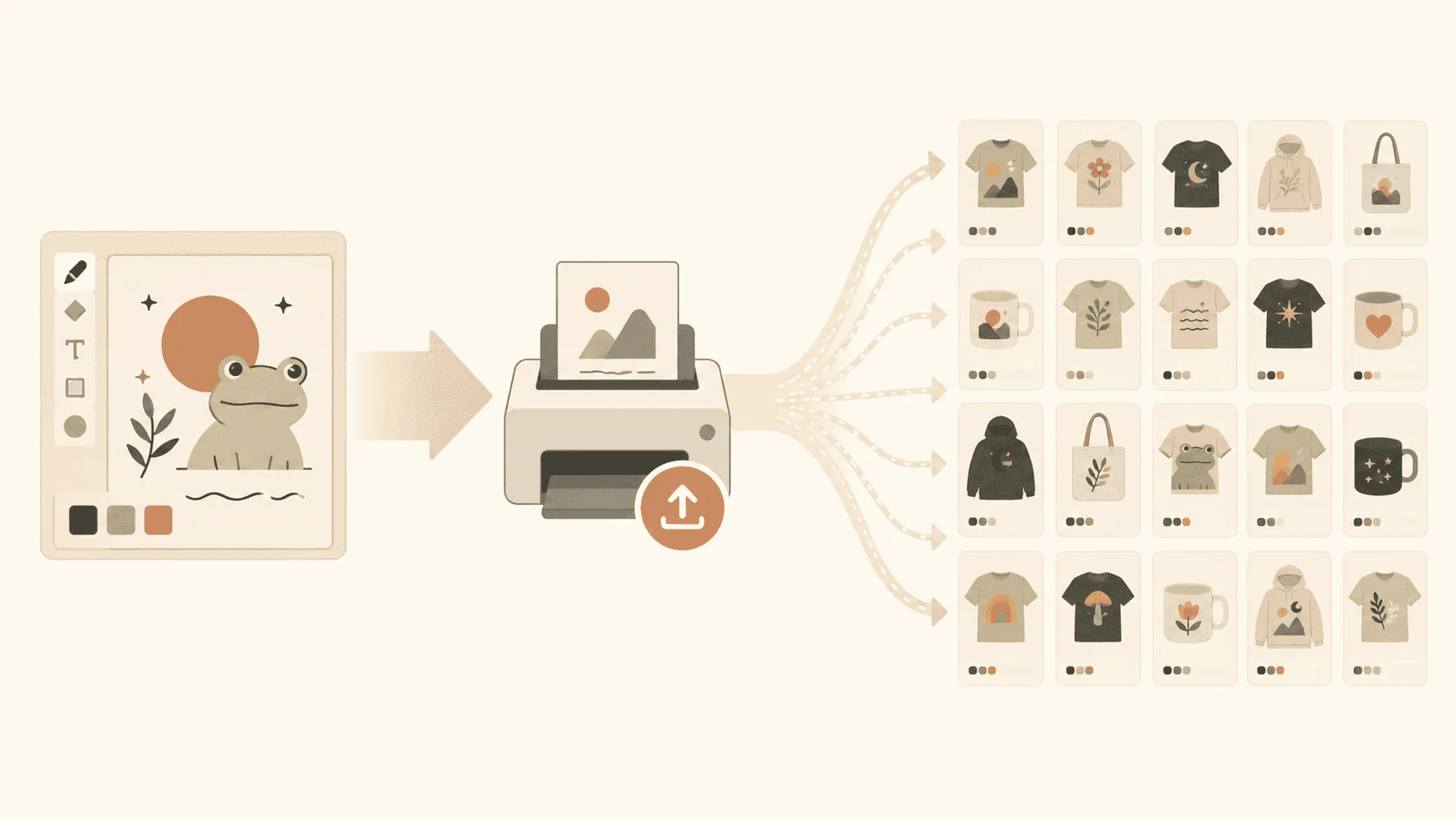
Once fulfilment is proven, use this design-to-100-listings workflow to scale the catalog without lowering listing quality.